
EV-DO (HRPD) Overview
EV-DO is the user-facing name for 1xEV-DO. The 3GPP2 specifications call the same air interface HRPD, for High Rate Packet Data (defined in IS-856). It is still part of the CDMA2000 family, but it does not carry voice and packet data on the same 1x traffic channel. HRPD gives packet data its own 1.25 MHz carrier and spends each forward-link slot on the device that can use it best.
In 1xBTS, HRPD is a single-sector data cell. A device can acquire the HRPD sector, receive a UATI, open an HRPD traffic connection, negotiate PPP, receive an IP address, and pass IP traffic through the PCF/PDSN packet core.
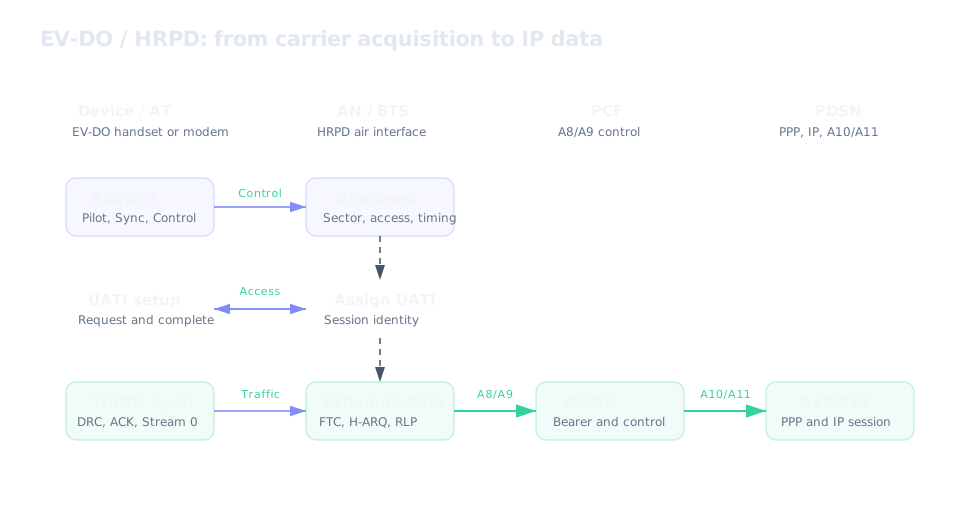
Names you’ll see
| Term | Meaning |
|---|---|
| EV-DO | The familiar product name for the high-rate CDMA packet-data carrier. |
| HRPD | The standards name: High Rate Packet Data. 1xBTS uses this name in code and logs. |
| AT | Access Terminal: the handset, modem, or data card. |
| AN | Access Network: the HRPD radio/session side that serves the AT. |
| UATI | Unicast Access Terminal Identifier, the HRPD session identity assigned by the AN. |
| DRC | Data Rate Control, the AT’s reverse-link report of the forward rate it wants. |
| FTC / RTC | Forward Traffic Channel and Reverse Traffic Channel. |
| PCF / PDSN | Packet Control Function and Packet Data Serving Node, the packet-core side. |
How it differs from 1x packet data
Both 1x packet data and HRPD eventually deliver IP through PPP and the PDSN. The radio side is different.
| Area | CDMA2000 1x packet data | EV-DO / HRPD |
|---|---|---|
| Carrier use | Shares the 1x carrier with voice, SMS, and signaling. | Uses a separate data-only carrier. |
| Forward scheduling | A traffic channel is assigned to a device. | The sector schedules forward packets by slot and DRC. |
| Device identity | Uses 1x mobile identity and service negotiation. | Uses HRPD UATI/session identity. |
| Packet path | 1x traffic channel to PCF/PDSN. | HRPD Stream/RLP to A8/A10 bearer and PDSN. |
| 1xBTS scope | SO7/SO33 packet data. | HRPD Rev 0/Rev A single-sector data carrier with packet data. |
The rest of this section
The remaining pages walk the HRPD session from the air interface up to the packet core:
- Channels & Acquisition — the forward and reverse HRPD air interface and how the sector schedules forward packets.
- Sessions & UATI — AT/AN roles and the UATI exchange that gives a device its HRPD session identity.
- Connections & Data Path — opening a traffic connection, HRPD streams, and the bridge to the PCF/PDSN packet core.
What 1xBTS implements today
The current implementation supports HRPD Rev 0 and Rev A on a single-sector data carrier. The working path is:
- Combined 1x + HRPD composite RF operation, plus supported HRPD-only deployment for EV-DO-only cells.
- Rev A personality negotiation with capable devices.
- Forward Pilot, Sync, QuickConfig, SectorParameters, AccessParameters, and BroadcastReverseRateLimit.
- Reverse Access Channel decode for UATI, route update, connection request, and keepalive messages.
- Reverse Traffic Channel pilot/DRC/ACK/data decode, plus per-slot reverse power control.
- UATI/session state, traffic assignment, RTCAck, TrafficChannelComplete, and session close handling in the AN.
- Default Signaling and Default Packet Application framing for PPP/IP traffic.
- Tested Rev A data throughput around 2.6 Mbps downlink and 1.4 Mbps uplink after protocol overhead.
- A8/A10 keyed-GRE bearer transport, with UDP-encapsulated GRE as the default and native GRE available when the host allows raw sockets.
- A9/A11 packet-core control signaling between AN, PCF, and PDSN.
- Optional A21 coordination between the 1x BSC and HRPD AN for hybrid-device identity and paging behavior.
Limitations
- One HRPD carrier and one sector. No handoff between sectors.
- Rev B, multi-sector handoff, and production security are not implemented.
- UATI/session state is not persisted across restarts.
See EV-DO (HRPD) for configuration and Packet Data Setup for IP routing, DNS, and host networking.