
Channels
Physical channels, logical channel mappings, and what 1xBTS currently supports.
Channel Architecture
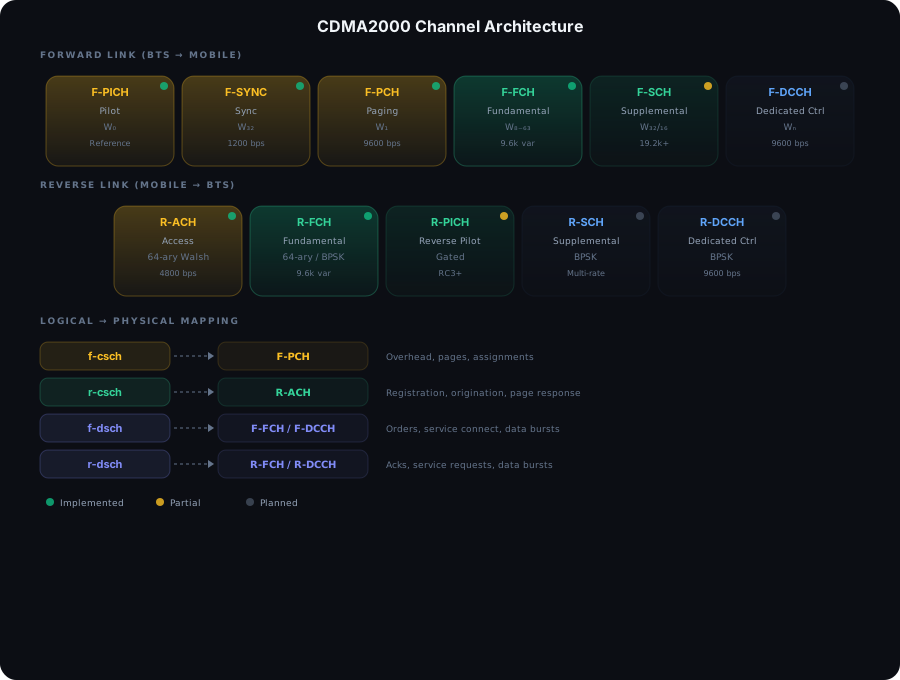
Forward Link Channels (BTS to Mobile)
The forward link carries signals from the base station to mobiles. All forward channels are code-multiplexed using Walsh codes on the same RF carrier.
F-PICH — Pilot Channel
The pilot is a constant, unmodulated signal on Walsh code 0. It carries no data — its purpose is to provide a timing and phase reference that mobiles use for:
- Acquisition — Finding and synchronizing to the base station
- Coherent demodulation — Phase reference for decoding other channels
- Signal strength measurement — Pilot Ec/Io drives handoff and power control decisions
The pilot is always transmitted at the highest power. Every other channel is measured relative to it.
1xBTS status: Implemented. Gain configurable.
F-SYNC — Sync Channel
The sync channel on Walsh code 32 broadcasts system timing at 1200 bps. After acquiring the pilot, the mobile reads the sync channel to learn:
- System time (synchronized to GPS)
- The base station’s PN offset
- Protocol revision
- Paging channel configuration
The sync channel uses a 26.67 ms superframe (3 frames per 80 ms) with R=1/2 K=9 convolutional coding and 2x symbol repetition.
1xBTS status: Implemented. R=1/2 convolutional coding, block interleaving.
F-PCH — Paging Channel
The paging channel on Walsh code 1 is the primary forward common signaling channel. It carries:
- Overhead messages — System Parameters, Access Parameters, the band-appropriate Neighbor List, and Extended System Parameters
- Page messages — General Page Message to alert specific mobiles
- Channel assignments — Extended Channel Assignment Message (ECAM) directing mobiles to traffic channels
- Directed orders — Authentication challenges, service redirection
Data rate is configurable at 9600 bps or 4800 bps. At 9600 bps, each 20 ms frame carries 172 information bits after R=1/2 encoding. Long code scrambling provides privacy.
Mobiles use slotted paging — each mobile only monitors its assigned slot (determined by IMSI hash), waking up periodically rather than listening continuously.
1xBTS status: Implemented. 9600/4800 bps, full overhead message broadcast, General Page, ECAM.
F-FCH — Forward Fundamental Channel
The fundamental channel is the primary traffic channel, carrying voice frames and signaling during active calls and data sessions. Walsh code is dynamically assigned from the available pool (typically W8-W63, avoiding reserved codes).
RC1 (IS-95A Compatible)
| Rate | Info Bits | CRC | Encoding | Repetition |
|---|---|---|---|---|
| 9600 bps (full) | 172 | CRC-12 | R=1/2 K=9 | 1x |
| 4800 bps (half) | 80 | CRC-8 | R=1/2 K=9 | 2x |
| 2400 bps (quarter) | 40 | — | R=1/2 K=9 | 4x |
| 1200 bps (eighth) | 16 | — | R=1/2 K=9 | 8x |
All rates produce 384 symbols after encoding and repetition. Forward modulation is BPSK.
RC2 (IS-95B Rate Set 2)
Uses R=1/2 K=9 convolutional coding and BPSK modulation at 14400/7200/3600/1800 bps. 1xBTS selects RC2 for QCELP 13K calls.
RC3 (CDMA2000 1x)
Uses R=1/4 K=9 convolutional coding and QPSK modulation. Supports the same 9600 bps base rate with variable rates, plus per-PCG power control. 768 modulation symbols per frame map to 384 QPSK symbol pairs.
1xBTS status: Implemented for RC1, RC2, and RC3. Variable-rate traffic and in-call signaling are supported.
F-SCH — Forward Supplemental Channel
The supplemental channel provides additional downlink data bandwidth alongside the fundamental channel. It uses a separate Walsh code with a shorter spreading factor for higher rates. In 1xBTS, SO33 packet sessions can enable RC3 F-SCH while reverse data remains on R-FCH.
| Rate | Walsh | RLP Payload / 20 ms | RLP Payload Capacity | Status |
|---|---|---|---|---|
| 19.2 kbps | W(32) | 40 bytes | 16.0 kbps | Implemented |
| 38.4 kbps | W(16) | 80 bytes | 32.0 kbps | Implemented |
| 76.8 kbps | W(8) | 160 bytes | 64.0 kbps | Implemented |
| 153.6 kbps | W(4) | 336 bytes | 134.4 kbps | Implemented |
Higher rates use shorter Walsh codes, consuming more of the code space but providing proportionally more bandwidth. The supplemental channel has its own long code mask and power control gain offset.
1xBTS status: RC3 F-SCH is implemented for SO33 downlink at 19.2, 38.4, 76.8, and 153.6 kbps. 9600 is the FCH data rate and is not a valid F-SCH rate. R-SCH is still planned.
F-DCCH — Forward Dedicated Control Channel
A planned dedicated signaling channel that runs alongside or instead of the fundamental channel. Unlike the FCH which multiplexes voice/data with signaling, the DCCH carries only signaling at a fixed rate (9600 bps for RC3).
Benefits:
- No voice interruption for signaling (no dim-and-burst needed)
- DTX capability — can stop transmitting when idle
- Simpler framing (fixed rate, no blind rate detection)
1xBTS status: Planned. Design document covers 6 implementation phases.
Other Forward Channels (Not Implemented)
| Channel | Purpose | Notes |
|---|---|---|
| F-QPCH | Quick Paging | Tells mobile whether to check F-PCH this slot |
| F-BCCH | Broadcast Control | Enhanced system info broadcast |
| F-CCCH | Common Control | Enhanced common signaling (replaces F-PCH) |
| F-CACH | Common Assignment | ACKs for Enhanced Access Channel |
| F-PDCH | Packet Data | High-speed packet (RC10) |
Reverse Link Channels (Mobile to BTS)
The reverse link carries signals from mobiles to the base station. Unlike the forward link, reverse channels from different mobiles are separated by long code masks rather than Walsh codes.
R-ACH — Reverse Access Channel
The access channel is how mobiles initiate contact with the network. It carries:
- Registration messages
- Origination messages (MO calls, data, SMS)
- Page response messages
The access channel operates at 4800 bps with 20 ms frames. Encoding uses R=1/3 K=9 convolutional code. Modulation is 64-ary orthogonal — each group of 6 coded bits selects one of 64 Walsh functions, providing processing gain.
Access is random with collision avoidance:
- Mobile picks a random access slot
- Transmits preamble + data
- Waits for acknowledgment
- If no ack, increases power and retries (access probe sequence)
1xBTS status: Implemented. Full access probe detection, L3 decode, ARQ acknowledgment.
R-FCH — Reverse Fundamental Channel
The reverse traffic channel, carrying voice frames and signaling from the mobile during active sessions.
RC1
Uses 64-ary orthogonal modulation at variable rates (9600/4800/2400/1200 bps). The base station performs blind rate detection — it Viterbi-decodes at each rate and checks the CRC to determine which rate the mobile transmitted.
Encoding: R=1/3 K=9 convolutional.
RC3
Uses BPSK modulation with a continuous reverse pilot. The pilot provides a coherent reference for the base station’s receiver, enabling better demodulation than RC1’s non-coherent detection.
Per-PCG power control operates at 800 Hz (one power control bit per 1.25 ms power control group).
1xBTS status: RC1 implemented with full pipelined receiver (pilot search, frame alignment, Walsh despreading, Viterbi decode, CRC check). RC3 reverse partially implemented.
R-PICH — Reverse Pilot Channel
Present only for RC3 and higher. The reverse pilot is a continuous (or gated) reference signal that the base station uses for coherent demodulation of the reverse traffic channel. It also carries the power control subchannel.
In gated mode, the pilot is only transmitted during active power control groups, saving mobile battery when the traffic channel is idle.
1xBTS status: Partial support (framework for RC3 gated pilot).
Other Reverse Channels (Not Implemented)
| Channel | Purpose | Notes |
|---|---|---|
| R-EACH | Enhanced Access | Shorter frames (5/10/20 ms), reservation mode |
| R-SCH | Supplemental | High-rate reverse data (multi-rate, turbo) |
| R-DCCH | Dedicated Control | Fixed-rate reverse signaling |
| R-PDCH | Packet Data | High-speed reverse packet (RC7) |
Logical Channels
CDMA2000 defines logical channels that map to physical channels depending on the system configuration:
Forward Logical Channels
| Logical | Physical | Purpose |
|---|---|---|
| f-csch (Common Signaling) | F-PCH | Overhead broadcasts, paging, channel assignment |
| f-dsch (Dedicated Signaling) | F-FCH or F-DCCH | Traffic channel signaling (orders, service connect, data bursts) |
In current 1xBTS, f-csch maps exclusively to F-PCH and f-dsch maps to F-FCH (since F-DCCH is not yet implemented).
Reverse Logical Channels
| Logical | Physical | Purpose |
|---|---|---|
| r-csch (Common Signaling) | R-ACH | Registration, origination, page response |
| r-dsch (Dedicated Signaling) | R-FCH or R-DCCH | Traffic channel signaling (acks, service requests, data bursts) |
Similarly, r-csch maps to R-ACH and r-dsch maps to R-FCH today.
Composite Channels
A “traffic channel” in CDMA2000 is actually a composite of multiple physical channels:
Forward Traffic = F-FCH + F-DCCH (optional) + F-SCH (optional)
Reverse Traffic = R-FCH + R-DCCH (optional) + R-SCH (optional) + R-PICH (RC3+)
In 1xBTS today, forward packet-data traffic can use F-FCH plus RC3 F-SCH. Reverse traffic is R-FCH (plus R-PICH for RC3); R-SCH is not implemented yet.
Walsh Code Allocation
On the forward link, all channels share the same RF carrier and are separated by orthogonal Walsh codes. The standard SR1 system has 64 Walsh codes available:
| Walsh Code | Allocation | Notes |
|---|---|---|
| W0 | Pilot (F-PICH) | Always reserved |
| W1 | Paging (F-PCH) | Always reserved |
| W32 | Sync (F-SYNC) | Always reserved |
| W8–W63 | Traffic pool | Dynamically assigned per call |
When a traffic channel is established, the BSC allocates a Walsh code from the available pool. For supplemental channels (F-SCH) at higher rates, shorter Walsh codes are used (W32, W16, W8, W4), which consume proportionally more of the code space.
The maximum number of simultaneous traffic channels depends on Walsh code availability and the rates in use. At 9600 bps (W64), up to ~60 traffic channels are theoretically possible. With supplemental channels active, the capacity decreases.
For current SO33 packet data, f_sch_rate_bps is a carrier-wide policy. Every eligible packet session receives one F-FCH plus one F-SCH at that configured rate.
| F-SCH Rate | Walsh Length | W64 Code-Space Cost | Max Packet Sessions / Carrier |
|---|---|---|---|
| 19.2 kbps | W(32) | 2 W64 codes | 17 |
| 38.4 kbps | W(16) | 4 W64 codes | 10 |
| 76.8 kbps | W(8) | 8 W64 codes | 5 |
| 153.6 kbps | W(4) | 16 W64 codes | 2 |
The counts assume no other traffic users and the current allocator policy, which reserves the common channels and allocates F-FCH separately from F-SCH. Future burstable SCH support is planned so supplemental channels can be added and removed on demand instead of held for every packet session.
Convolutional Encoders
All channels use constraint-length 9 (K=9) convolutional encoders with different rates:
| Rate | Generators (octal) | Used By |
|---|---|---|
| R=1/2 | 753, 561 | F-FCH RC1, F-PCH, F-SYNC |
| R=1/3 | 557, 663, 711 | R-ACH, R-FCH RC1 |
| R=1/4 | 765, 671, 513, 473 | F-FCH RC3, F-SCH RC3 |
Some higher-rate supplemental profiles use turbo coding instead of convolutional coding for better performance at low Eb/No. Turbo encoding is not yet implemented in 1xBTS.
Implementation Status Summary
| Channel | Direction | Status | Notes |
|---|---|---|---|
| F-PICH | Forward | Implemented | Pilot reference |
| F-SYNC | Forward | Implemented | 1200 bps system timing |
| F-PCH | Forward | Implemented | 9600/4800 bps paging |
| F-FCH RC1 | Forward | Implemented | Variable rate voice/data |
| F-FCH RC3 | Forward | Implemented | QPSK, R=1/4 |
| F-SCH RC3 | Forward | Implemented | 19.2/38.4/76.8/153.6 kbps downlink |
| F-DCCH | Forward | Planned | 6-phase design |
| R-ACH | Reverse | Implemented | 4800 bps access |
| R-FCH RC1 | Reverse | Implemented | Full receiver pipeline |
| R-FCH RC3 | Reverse | Partial | Growing support |
| R-PICH | Reverse | Partial | RC3 pilot framework |
| R-SCH | Reverse | Planned | Reverse supplemental data |
| R-DCCH | Reverse | Planned | With F-DCCH |