
Layer 3 Messages
Layer 3 manages registration, call setup, service negotiation, and control operations. Defined in C.S0005-E, carried by the LAC sublayer.
Message Categories
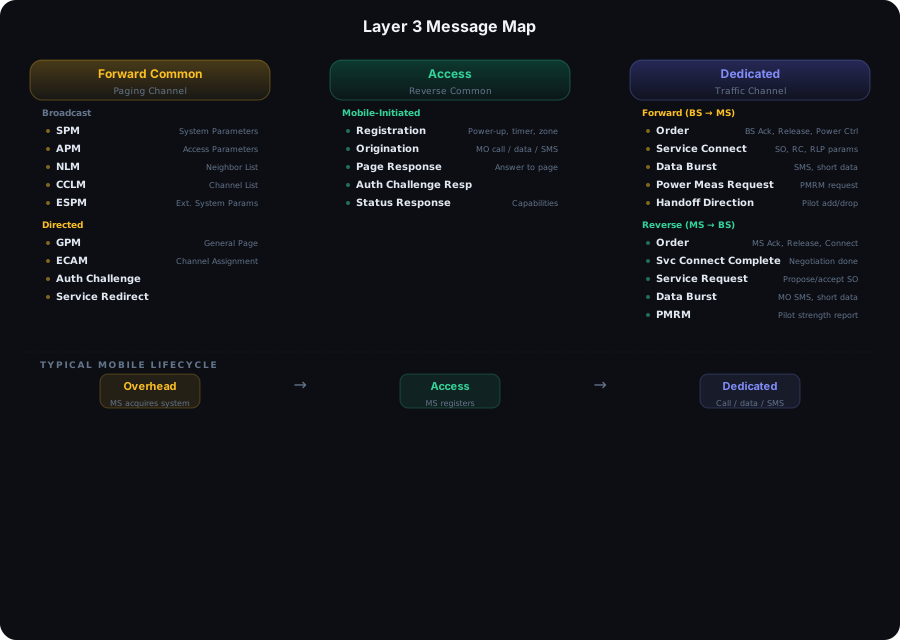
Layer 3 messages fall into three categories based on which channel carries them:
Overhead Messages (Forward Common Channel)
These are broadcast continuously on the paging channel to all mobiles in the cell. They define the operating parameters of the base station:
| Message | Purpose |
|---|---|
| System Parameters (SPM) | SID/NID, PN offset, registration parameters, paging channel config |
| Access Parameters (APM) | Access channel config — probe power, persistence, max retries |
| Neighbor List (NLM) | Band Class 0 neighbor pilot offsets for handoff |
| CDMA Channel List (CCLM) | Available CDMA channels and band classes |
| Extended System Parameters (ESPM) | TMSI config, P_REV, encryption support, additional system parameters |
| Extended Neighbor List (ENLM) | Neighbor pilots, priorities, bands, and channels for non-BC0 operation |
These messages are not acknowledged — they repeat on a cycle, and a mobile that misses one will receive it on the next pass. The base station configures the broadcast interval for each message type.
Access Messages (Reverse Common Channel)
Sent by the mobile on the access channel to initiate contact with the network:
| Message | Purpose |
|---|---|
| Registration | Mobile announces its presence — initial, periodic, zone-based, or parameter-change registration |
| Origination | Mobile-originated call or data session request with service option |
| Page Response | Mobile responds to a page (MT call or SMS) |
| Authentication Challenge Response / Resync | Response to authentication challenge or sync from the base station |
| Status Response / Extended Status Response | Mobile reports capabilities, band class support, etc. |
| Device Information | Reports device capabilities and identifiers |
| Security Mode Request | Mobile-initiated security mode change |
| Reconnect | Reconnect after loss of traffic channel |
| Radio Environment | Reports observed radio environment |
| Flash With Info | Mid-call signaling such as three-way calling or call waiting |
| General Extension | Container for vendor or extended messages |
Each access message includes the mobile’s identity (MSID_TYPE + identity payload) so the network knows who is transmitting. See Identity & Addressing for details on identity encoding.
Directed Messages (Forward Common Channel)
These target a specific mobile on the paging channel using the addressing mechanism:
| Message | Purpose |
|---|---|
| General Page (GPM) | Pages one or more mobiles for incoming calls, SMS, or registration |
| Channel Assignment | Assigns a traffic channel — includes Walsh code, frequency, power settings |
| Extended Channel Assignment (ECAM) | Enhanced assignment with RC negotiation and supplemental channel support |
| Service Redirection | Redirects mobile to a different system or frequency |
| Authentication Challenge | Initiates challenge-response authentication |
Traffic Channel Messages (Dedicated Channel)
Once a mobile is assigned a traffic channel, all signaling moves to the dedicated channel (f-dsch / r-dsch):
Forward (BS → MS)
| Message | Purpose |
|---|---|
| Order | General-purpose control — BS Ack, Release, Power Control, Long Code Transition, etc. |
| Service Connect | Completes service negotiation — specifies service option, RC, RLP parameters |
| Service Response | Counter-proposal during service negotiation |
| Data Burst | Carries SMS, position location, or other non-voice/data payload |
| Power Measurement Report Request | Requests pilot strength measurements from the mobile |
| Handoff Direction | Instructs mobile to add/remove pilots or switch frequencies |
Reverse (MS → BS)
| Message | Purpose |
|---|---|
| Order | MS Ack, Release, Connect (answer), Reject, Reduced Slot Cycle, etc. |
| Service Request | Mobile proposes a service option |
| Service Response | Mobile counter-proposes during negotiation |
| Service Connect Complete | Confirms service negotiation is done — conversation can begin |
| Service Option Control | Mid-call service option control updates |
| Data Burst | Mobile-originated SMS, short data |
| Send Burst DTMF | DTMF digit transmission |
| Pilot Measurement Report (PMRM) | Reports received pilot strengths for handoff decisions |
| Periodic Pilot Strength Measurement | Periodic PSMM variant for power and handoff tracking |
| Origination Continuation | Additional info for an origination (dialed digits, etc.) |
| Status Message | Mobile status responses on the traffic channel |
| Handoff Completion | Confirms hard handoff completion |
| Parameters Response | Response to a parameter query from the network |
| Power Measurement Report | Forward link Eb/Nt and FER report |
| Outer Loop Report | Reverse outer-loop FER target reporting |
| Supplemental Channel Request | Mobile requests F-SCH or R-SCH allocation |
| Candidate Frequency Search Response/Report | Inter-frequency handoff candidate measurements |
| Resource Request | Generic resource allocation request |
| Extended Release Response | Confirms extended release procedure |
Order Messages
The Order message is a versatile container used for many control functions. The ORDER field (6 bits) identifies the specific order:
| Order | Code | Direction | Purpose |
|---|---|---|---|
| BS Ack | 010000 | F | Acknowledges a reverse message (also carries ACK_SEQ) |
| MS Ack | 010000 | R | Acknowledges a forward message |
| Release | 011001 | F/R | Initiates or confirms call teardown |
| Connect | 010001 | R | Mobile answers an incoming call |
| Long Code Transition | 000001 | F | Switch from public to private long code |
| Power Control Parameters | specific | F | Adjust power control step size and target |
| Base Station Challenge Confirm | specific | F | Confirms auth challenge response |
The BS Ack Order is the most common — it’s the mechanism for acknowledging traffic channel messages when the base station has no other pending signaling to send.
Registration & Call Setup
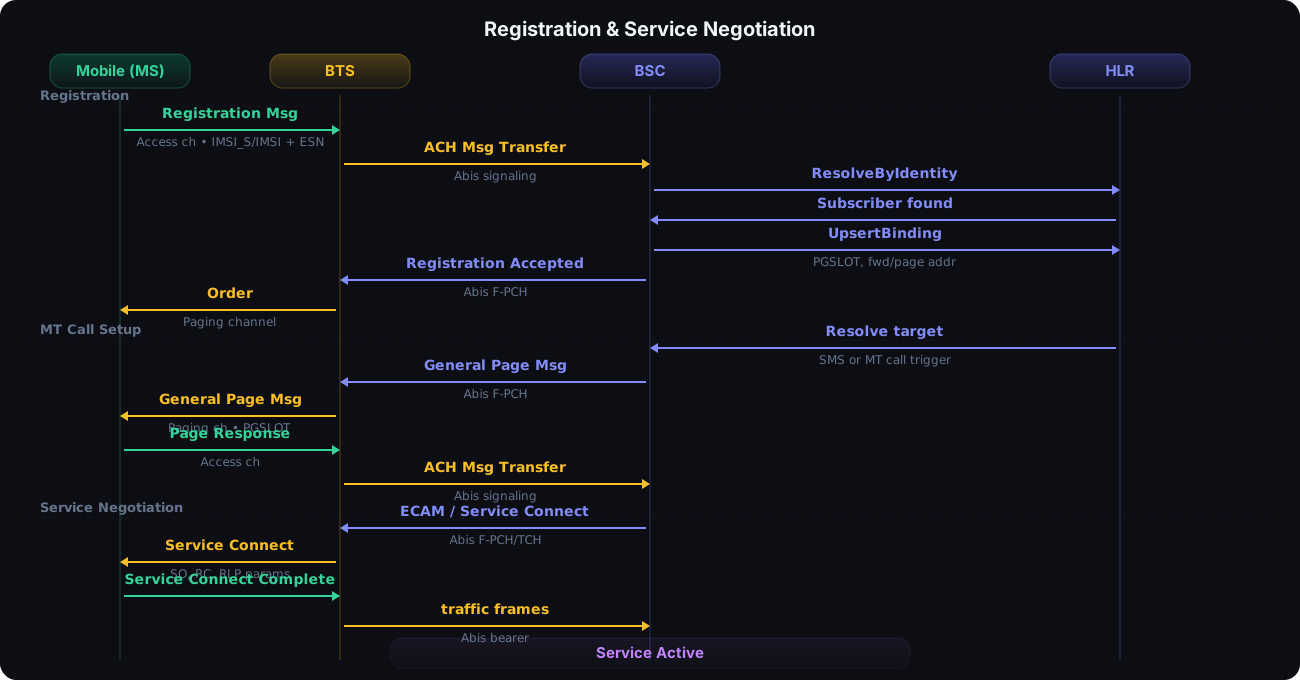
Registration is how a mobile announces its presence to the network. CDMA2000 supports several registration types, controlled by parameters in the System Parameters Message:
| Type | Trigger | SPM Parameter |
|---|---|---|
| Power-up | Mobile turns on | POWER_UP_REG |
| Power-down | Mobile turns off | POWER_DOWN_REG |
| Timer-based | Periodic interval expires | REG_PRD (registration period) |
| Zone-based | Mobile enters a new zone (SID/NID/zone combination) | TOTAL_ZONES, ZONE_TIMER |
| Parameter-change | System parameters changed since last registration | PARAMETER_REG |
| Distance-based | Mobile moved beyond threshold | REG_DIST |
The Registration Message on the access channel includes:
- Mobile identity (ESN, IMSI, or both)
- Registration type
- Protocol revision (
MOB_P_REV) - Slot cycle index (power saving preference)
- Station class mark (device capabilities)
The base station acknowledges successful registration with an Order message or implicitly by including the mobile in a Page or Channel Assignment.
Service Negotiation
When a call or data session is established, the service option must be negotiated between the mobile and the base station:
MS BS │ │ │ Origination (requested SO) │ │ ──────────────────────────────────▶ │ │ │ │ Channel Assignment (ECAM) │ │ ◀────────────────────────────────── │ │ │ │ ── mobile tunes to traffic ch ── │ │ │ │ Service Connect │ │ (accepted SO, RC, RLP) │ │ ◀────────────────────────────────── │ │ │ │ Service Connect Complete │ │ ──────────────────────────────────▶ │ │ │ │ ═══ service active ═══ │The Service Connect Message specifies:
- Service option — SO1/SO3/SO68/SO70/SO32768 for voice, SO7/SO33 for data
- Radio configuration — RC1, RC2, or RC3 for forward and reverse
- RLP parameters — For data sessions: RLP type, sequence number width, NAK parameters
- Forward/reverse traffic config — Rate set, supplemental channel allocation
For SO33 F-SCH, 1xBTS assigns the supplemental channel after the service configuration is accepted. The BSC allocates a separate F-SCH bearer over Abis, sends Extended Supplemental Channel Assignment Message (ESCAM), and starts forwarding supplemental downlink data after the mobile acknowledges the assignment.
If the mobile doesn’t support the proposed service option, it can reject or counter-propose during traffic-channel negotiation. 1xBTS decodes traffic-channel Mobile Station Reject Orders with the rejected message type, order, parameter ID, record, connection reference, and any trailing bytes when those fields are present.
General Page Message
The General Page Message (GPM) is the primary mechanism for reaching idle mobiles. It can carry multiple page records in a single message, each targeting a different mobile:
Page Record Types
| Class | Addressing | Use Case |
|---|---|---|
| Class 0 | IMSI_S (IMSI_M_S1 + IMSI_M_S2) | Standard paging, most common |
| Class 1 | ESN | Paging by device serial number |
| Class 2 | IMSI (full, with MCC) | International roaming |
| TMSI | TMSI zone + code | Privacy-enhanced paging |
Each page record includes:
- Address — The target mobile’s identity
- Special Service flag — Whether a specific service option is being requested
- Service Option — If special service is set, the requested SO
Slotted Paging
Mobiles don’t monitor the paging channel continuously — they wake up only during their assigned paging slot (computed from IMSI_S, see Identity & Addressing). The base station must transmit the page during the correct slot for the target mobile to receive it.
Data Burst Message
The Data Burst Message is a general-purpose container for non-voice, non-packet data payloads. It’s used for:
- SMS delivery — Both MO (mobile → network) and MT (network → mobile) SMS messages are carried as data bursts
- Position location — GPS or network-based location data
- Short data burst — Application-specific small data payloads
Data bursts can be sent on either the paging channel (for idle mobiles) or the traffic channel (for active sessions). The burst type field identifies the payload format.
Message Encoding
Channel-Specific Encoding
Different channels use different message identifier formats:
| Channel | ID Field | Size | Encoding |
|---|---|---|---|
| Forward common (paging) | MSG_TAG | 8 bits | Fixed table per C.S0004-E |
| Reverse common (access) | Variable | varies | PD + MSG_ID/MSG_TAG |
| Forward dedicated (traffic) | MSG_TYPE | 8 bits | Fixed table per C.S0004-E |
| Reverse dedicated (traffic) | Variable | varies | Length-prefixed |
PDU Structure (Traffic Channel Example)
A typical forward dedicated channel PDU:
MSG_TYPE (8) — Message identifierACK_SEQ (3) — Acknowledging reverse messageMSG_SEQ (3) — Sequence number of this messageACK_REQ (1) — Requesting acknowledgmentENCRYPT (2) — Encryption mode (00 = none)SDU (var) — The Layer 3 message bodyPADDING (var) — Zeros to byte boundaryThis PDU is then wrapped in the SAR envelope (MSG_LENGTH + CRC-16) and fragmented into MuxPDU frames for physical layer transmission. See Protocol Layers for the full encapsulation chain.