
Overview
1xBTS is an open-source CDMA2000 1x and EV-DO Rev 0/Rev A cellular network. It implements the 1x and HRPD air-interface pieces from scratch and separates the BTS, BSC, HRPD AN, MSC, packet-core, HLR, SMSC, voice gateway, and management-plane responsibilities behind explicit interfaces.
Packet data uses a shared PCF/PDSN model. 1x SO7/SO33 data reaches the packet core through the BSC radio edge and PCF packet client boundary; EV-DO / HRPD data reaches it through the AN over A8/A9. In both cases the PCF handles packet setup at the radio edge and the PDSN provides PPP/IP service. HRPD A8/A10 bearer transport is configured in the packet-core JSON files.
Components
| Component | Role |
|---|---|
| BTS Base Transceiver Station | Radio execution — PHY, local MAC/LAC, TX/RX scheduling, pipelined receiver, frame alignment, radio metrics |
| BSC Base Station Controller | Radio network control — mobile state, paging policy, traffic assignment, Abis peer state, A1/A2p/A9 edge |
| AN HRPD Access Network | EV-DO session side — UATI assignment, HRPD connection state, Default Signaling, Default Packet Application streams, A8/A9 edge |
| MSC Mobile Switching Center | Circuit-service control — A1 call state, A2p RTP bearer setup, voice media orchestration, preemption, and SIP gateway control |
| PCF Packet Control Function | Packet-data radio edge — 1x packet client boundary, HRPD A8/A9 session setup, air-link coordination, and A11 registration toward the PDSN |
| PDSN Packet Data Serving Node | Packet-data anchor — A10/A11 side, PPP/IPCP, TUN/FOU/FOU-TCP transport, packet service gRPC |
| HLR Home Location Register | Subscriber service — identity resolution and registration bindings over HLR gRPC, backed by PostgreSQL |
| SMSC Short Message Service Center | SMS service — message submission, delivery tracking, welcome SMS injection, persistent queue over SMSC gRPC backed by PostgreSQL |
| Voice Codecs QCELP and EVRC | TIA-96/QCELP 8K, QCELP 13K, EVRC-A, EVRC-B, and EVRC-WB |
| Voice Gateway SIP/PSTN bridge | Bidirectional bridging to SIP trunks — outbound from a handset and inbound from a SIP caller, QCELP/EVRC↔G.711 transcoding |
| Management / Dashboard Operator plane | gRPC management plane plus Next.js/SSE UI for diagnostics and operator actions |
Capabilities
| Feature | Details |
|---|---|
| Voice Calls | MO/MT, QCELP/EVRC (SO1/SO3/SO68/SO70/SO32768), mixed-codec MS-to-MS bridging, existing-TCH MT setup, MSC-controlled SIP gateway (inbound and outbound) |
| SMS | MO/MT, PostgreSQL SMSC, paging + traffic delivery, welcome SMS on new/inactive registration |
| Packet Data | SO7 (RC1) + SO33 (RC3), PPP/IPCP, F-SCH downlink, TUN/FOU/FOU-TCP, authenticated PCF/PDSN A11 |
| EV-DO / HRPD | Rev 0/Rev A single-sector data carrier, UATI sessions, HRPD traffic connection, A8/A9 to PCF, shared PDSN/IP pool |
| Physical Layer | Pipelined RX, FFT pilot, Viterbi, RC1 + RC2 + RC3 |
| Power Control | 800 Hz inner loop, FER outer, PMRM forward |
| BTS/BSC Split | Abis signaling/bearer interface; embedded and remote-BTS modes |
| Packet Core | PCF/PDSN packet setup, A10 bearer transport, A11 authentication, packet service API |
| Web Dashboard | Live metrics, mobile tracking, message log, node-scoped management APIs |
| F-SCH | RC3 SO33 downlink at 19.2/38.4/76.8/153.6 kbps |
| RAKE | Multi-finger pipelined receiver, FFT + fast-path despread |
Architecture
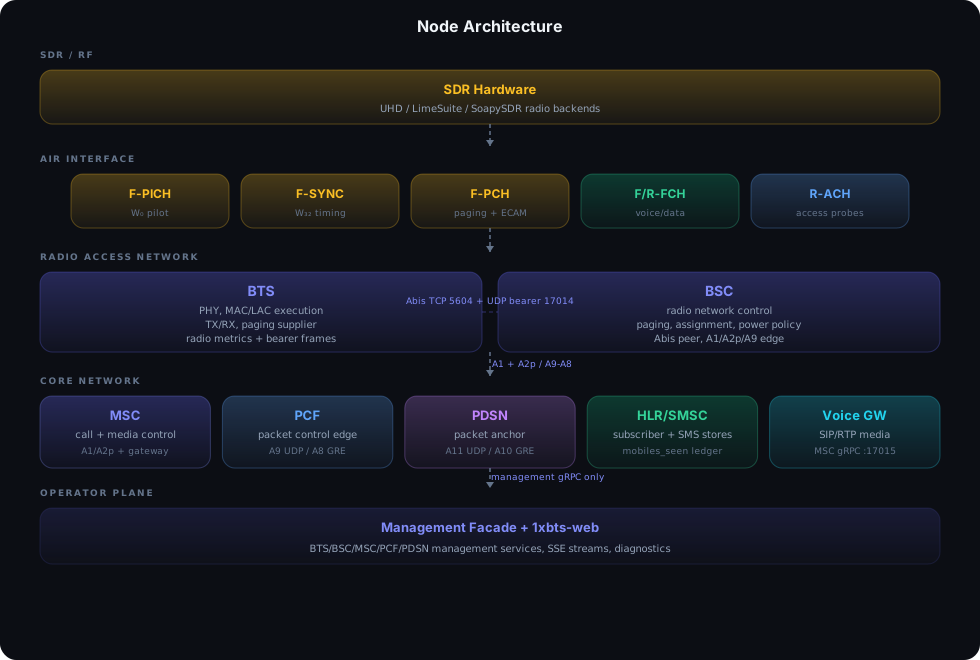
The system follows a layered architecture:
- Physical Layer — SDR hardware, PN spreading, Walsh channelization, pulse shaping, pipelined receiver
- MAC / LAC — Message sequencing (MSG_SEQ/ACK_SEQ), ARQ, interleaving, long code scrambling
- Layer 3 — IS-2000 signaling: registration, origination, paging, service negotiation
- Network Interfaces — Abis between BTS/BSC, A1 and A2p between BSC/MSC, the 1x BSC packet-client boundary into the PCF, HRPD A8/A9 from the AN into the PCF, A10/A11 between PCF/PDSN, and A21 coordination between 1x and HRPD
- Core Services — MSC, PCF, PDSN, HLR, SMSC, HRPD AN, voice gateway, and packet transport
- Management Plane — gRPC APIs for operator actions and diagnostics; not a replacement for standards interfaces
Next Steps
- Building from Source — Clone, build, set up the database
- Configuration — BTS and radio config files
- First Registration — Get a handset on the air
- EV-DO (HRPD) — Enable the dedicated Rev 0/Rev A data carrier